Monday, 23 July 2012

METROPOLITAN MUSEUM OF ART --- NEW-YORK


During a recent voyage to New York Ciiy, I had the occasion to go and draw at the  Metropolitan Museum of Art.  I drew only statues in the European sculptures hall.   As I was planning to come back to the museum the following day, I wanted to draw the Greek and Roman statues on this second visit.  But… I have not been able to come back to the Museum.
These were moments of intense pleasure.   But when I was starting to draw Hugolino,  one of the supervisors ordered me to bring the chair back to its place.  I was somewhat annoyed!   I had to  finish the drawing standing.   Fortunately all the others were done while sitting comfortably.  As usual, I added watercolour to the drawings in the evening.    They are all done with pen and permanent ink.   The last two drawings were done in a previous visit.


Tuesday, 17 July 2012

QUEBEC CITY-2012


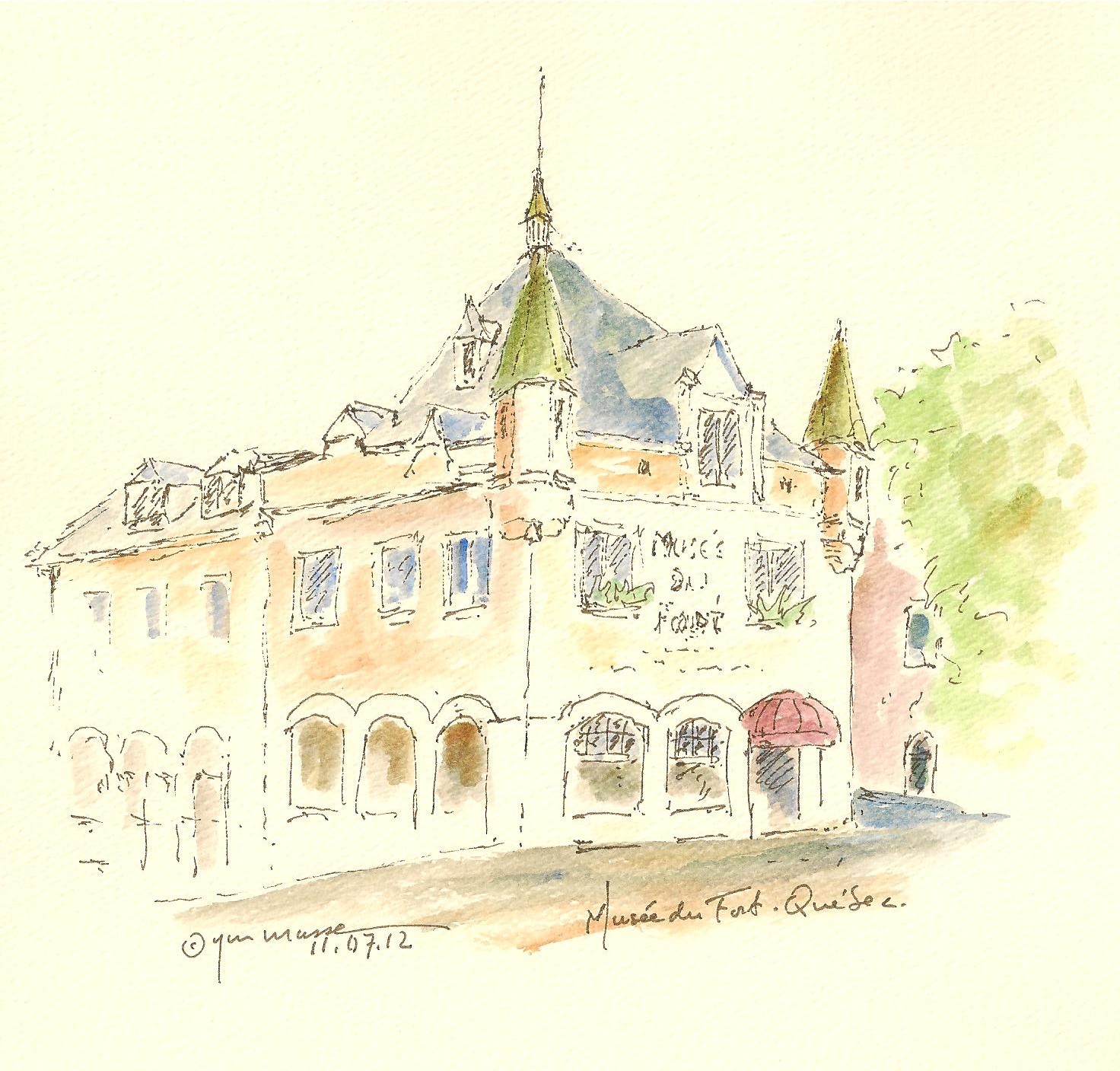
A few days spent in the City of Quebec enabled me to quickly draw a tiny part of the million beautiful things of this historical city.   The weather was very hot and I sought the shade to work at ease.  It is to be noticed that the color was usually put in the evening.   It means that the buildings take a slightly different aspect as well because of my memory as by my inclination to put such or such color not always in conformity with reality…


This time, there is no text on the history of the various buildings and places.   It should simply be remembered that the famous doors which give access to the old city had to be rebuild but not in the French style castles bur rather in the spirit of the Scottish castles and that the wall was saved by the English of Quebec because the municipality wanted to destroy them.

Sunday, 3 April 2011

LE CANAL DE LACHINE - Montréal


In
  1670, it was proposed to digg a canal.  Ten years later the idea was taken up again.  It would have two goals : the mills of Montreal needed water and the navigation toward Ontario  would be facilitated.   In 1689, the digging began.   The attack of Lachine by Iroquois put an end to the project.   It was resumed in 1700.  Another stop happened the following year for lack of funds.  In 1821, the merchants needed the canal.  It was therefore completed in 1825.  Initially opened for the flat-bottomed boats, it had to be widened twice allowing larger ships to pass through it.  It was also an important source of electric power for various manufactures which were established along the canal. It is said that before the great crisis of 1929, nearly 15,000 ships used it each year.  But thirty years later, to allow the transatlantic boats to go to Ontario, the Great Lakes  St. Lawrence Seaway took up the project.

The Canal lost its importance until 1997 when Parcs Canada (which was manageing  it since 1978) proposed a project of revitalization of the canal.  Since 2002, many pleasure boats cross it to the great joy of the curious one.   Today, it has become a pride for Montreal.

 It measures 14,5 kilometers and connects the Old -Port and the lake Saint-Louis.  Its cycle track is very popular.   Various activities were set-up in order to make it possible for the population to benefit from this patrimonial richness.   Thus one can go on a one hour cruise which is very instructive. Lots of other activities are available : guided bicycle excursions are organized, photograph rallyes, commented  visits on foot to discover the history of the site,  dragon boats expeditions, rented pedal boats, electric motor boats and many others for those who are curious about the history or simply to enjoy the moment.


Wednesday, 28 April 2010

FRENCH UNION BUILDING - Montréal


429 rue Viger E.

This beautiful residence should be called Jacques -Felix Sincennes House, the owner's first name. It was built in 1867. In his youth, Sincennes learned about the navigation business, later became ship-owner, businessman and even touched on politics.

There was no steam navigation on the Richelieu River. J.F. Vincennes brought together the necessary funds and built a paddle boat/wheel and a barge to transport products of all sorts from the Richelieu river to Montreal and on the river. The success was such that Vincennes had to quit his position of captain to become first Secretary and then President of the company, the Compagnie du Richelieu. The latter took expansion but soon had to face competition and finally the two rivals formed new company that became the Steamship Lines in 1913.

Sincennes became Deputy in Richelieu from 1857 to 1861. He was also appointed judge. He lived his last years in Montreal.

The French Union took possession of the building in 1909 and organized conferences, fairs, exhibitions for many years, hence the current name of the building.

In front of the building, two statues have been erected. On the left side, Marianne, a symbolic figure representing the French Republic. It is a work of Paul Romain Chevré who survived the sinking of the Titanic. As might be expected, the other one is the statue of Joan of arc. This building is located in the Square Viger, an exceptional heritage sector. Therefore, it is protected for future generations.

Saturday, 24 April 2010

EDWARD-WILLIAM-GRAY / HOUSE AND WAREHOUSE


427-429, rue St. Vincent

This three floor house as well as its neighbor was built in 1785 by Edward William Gray, one of the first civilian British to settle in Montreal. Being a merchant, he was also Sheriff Deputy, grand provost, notary, lawyer, justice of the peace and station master. This house along with the building of the 437 would be the only commercial buildings dating from the 18th century. Gray lived the largest building while the smallest served as a warehouse. The exterior of these two witnesses of the past suffered almost no change. In 1810, E.W. Gray died and his wife kept the house until 1825. Then a nephew and partner, Frederick William Ermatinger who was also Sheriff, became owner for two years.

Séraphino Giraldi, hotelkeeper and shopkeeper, bought it in 1828. It was then used as a small barrack, and after the construction of the law courts on Notre Dame Street, the tenants were rather men of law. One of them was the famous George-Étienne Cartier. Giraldi died in 1869, due to debts not paid, the Jacques-Cartier Bank became the owner of the building.

A printer, Adjuteur Carmel, rented the place in 1880 then purchased it later. He and his family staided there until 1919. A doctor followed, Stephen Langevin, in 1954. He also made different changes among them the slope roof which was changed to aflat roof. Then restaurants and breweries occupied the house. Bernard Beaudoin became owner of it in 1954 and his estate kept the building until 1970. A fire damaged the building in 1968 and Mr. Beaudoin restored it giving it its original appearance.

In 1969, the building was classified an historic monument.

H0TEL RICHELIEU - Old Montreal

443, rue Saint-Vincent

This building has had several names in its history, sometimes Hotel Richelieu, sometimes Club-Williams, at other times building Le Devoir and even the morgue of Montreal. It all began in 1858 or 1861, the past is sometimes nebulous.

Built by Roch Jacques Séraphino Giraldi, innkeeper and merchant, the building was leased and five law firms occupied parts of the building. Among these were George - Étienne Cartier, the "Father of Confederation", Severus Rivard, who has been Mayor of Montreal. The Giraldi estate retained its ownership of the building until 1873.

Joseph Béliveau bought the House to enlarge his hotel which was known as Hotel Richelieu. Three buildings formed the Hotel that was well renowned. The current building number 443 is the only one that remains.

Among the different owners, there was Isidore Brien dit Durocher. He was a U.S. Army veteran. It is said that he would have participated in the Secession war. During this war, several French Canadian enrolled. Some of them it is said, enrolled in a unit, received the sum that was offered to those who volunteered, then at the first opportunity they deserted to enlist again in another Regiment. After a few attempts, they came back with an interesting sum of money... and definitely richer than before!

From 1889 to 1910, a French lady was also the owner of the building without ever having seen or set foot in it, Mary Alice Beatrice Isabeau Saveuse de Beaujeu. Her husband was the owner of the hotel and she inherited it after his death and his children continued owning it for fifteen years. In 1925, the Government of Quebec became the owner.

A private club occupied the premises in 1912, the Jacques-Cartier Club where enthusiasts could engage in billiards, chess, cards and dominos. The Devoir was another owner from 1914 to 1924. The Morgue followed in 1969, but working conditions were far from ideal. It is said that corpses were disappearing mysteriously. The forensic laboratory, the third most ancient in the world and the first in North America, as well as the offices of the coroner also occupied the building.

Changes were made to the building. A fourth floor was added. The Interior also was adapted to printing conditions. Among the VI P who stayed at the hotel Richelieu, it’s worth mentioning Sarah Bernhardt, although other sources mention that his troupe members were those who slept in the Hotel while she lived in a different one.

Sunday, 4 April 2010